The Agentic AI Enterprise Series
The Post-Agile Guide to
AI-Assisted Development
Three books that show engineering leaders how to restructure teams, processes, and governance for the age of AI.
by Mark A. Smith
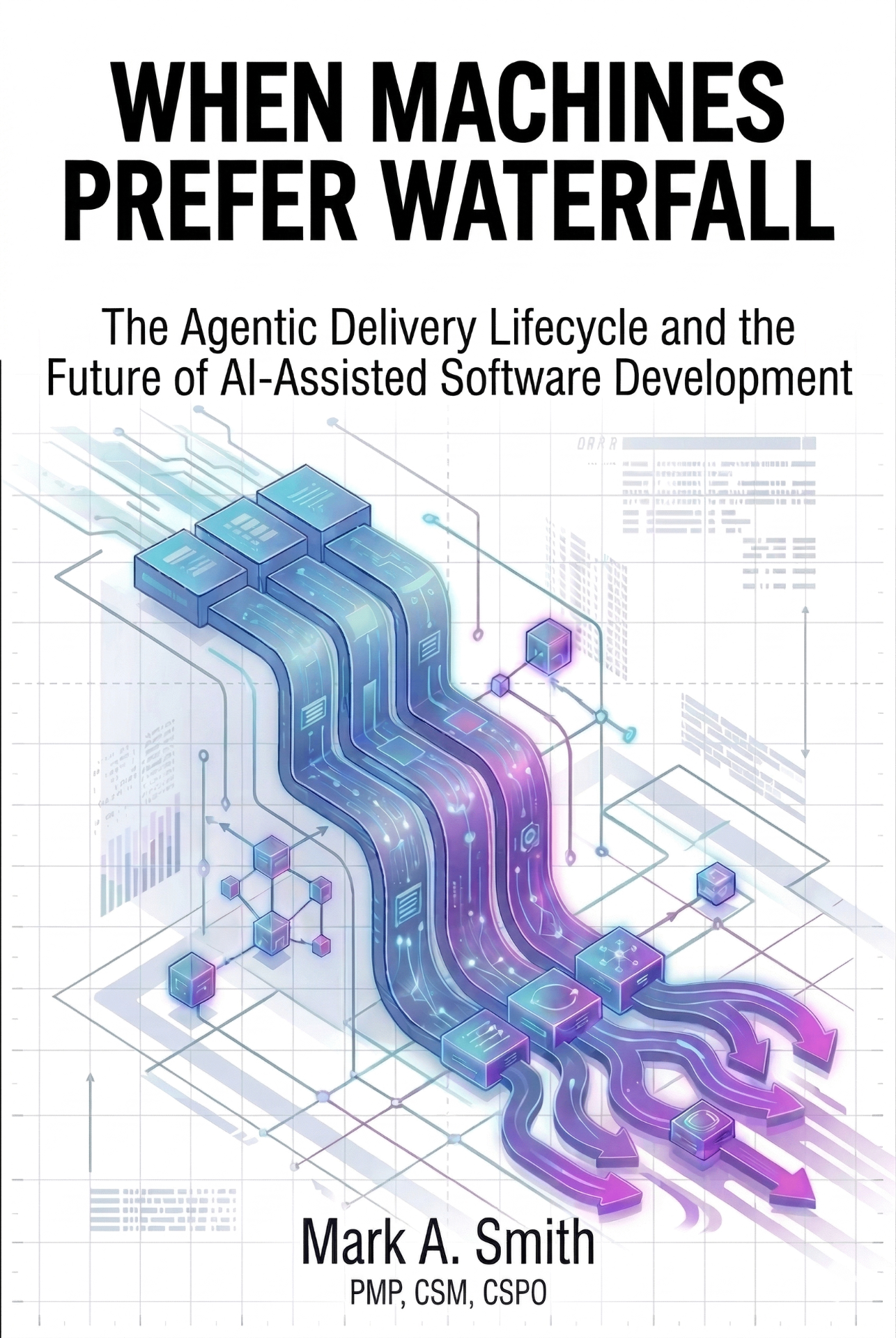
Book 1
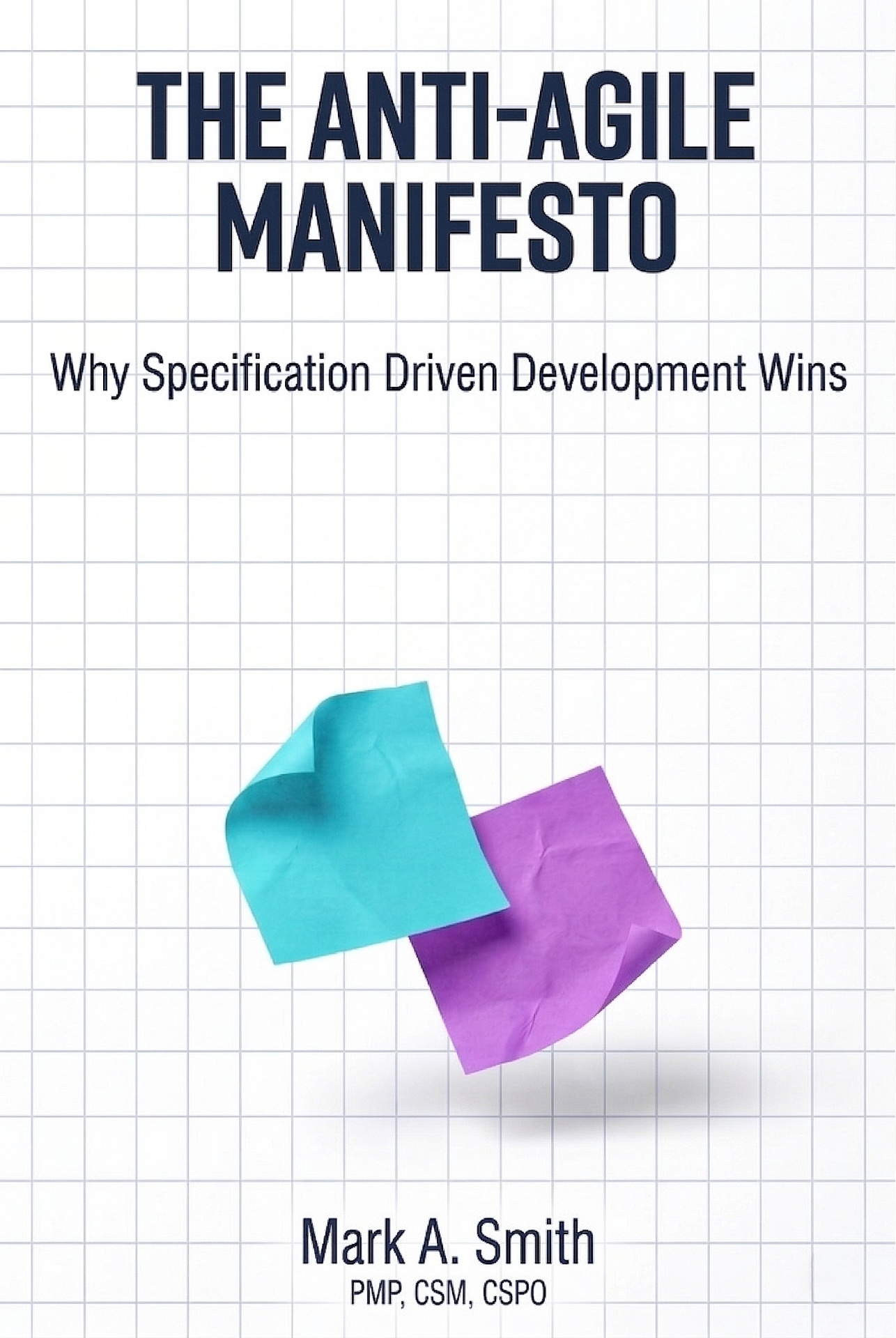
Book 2
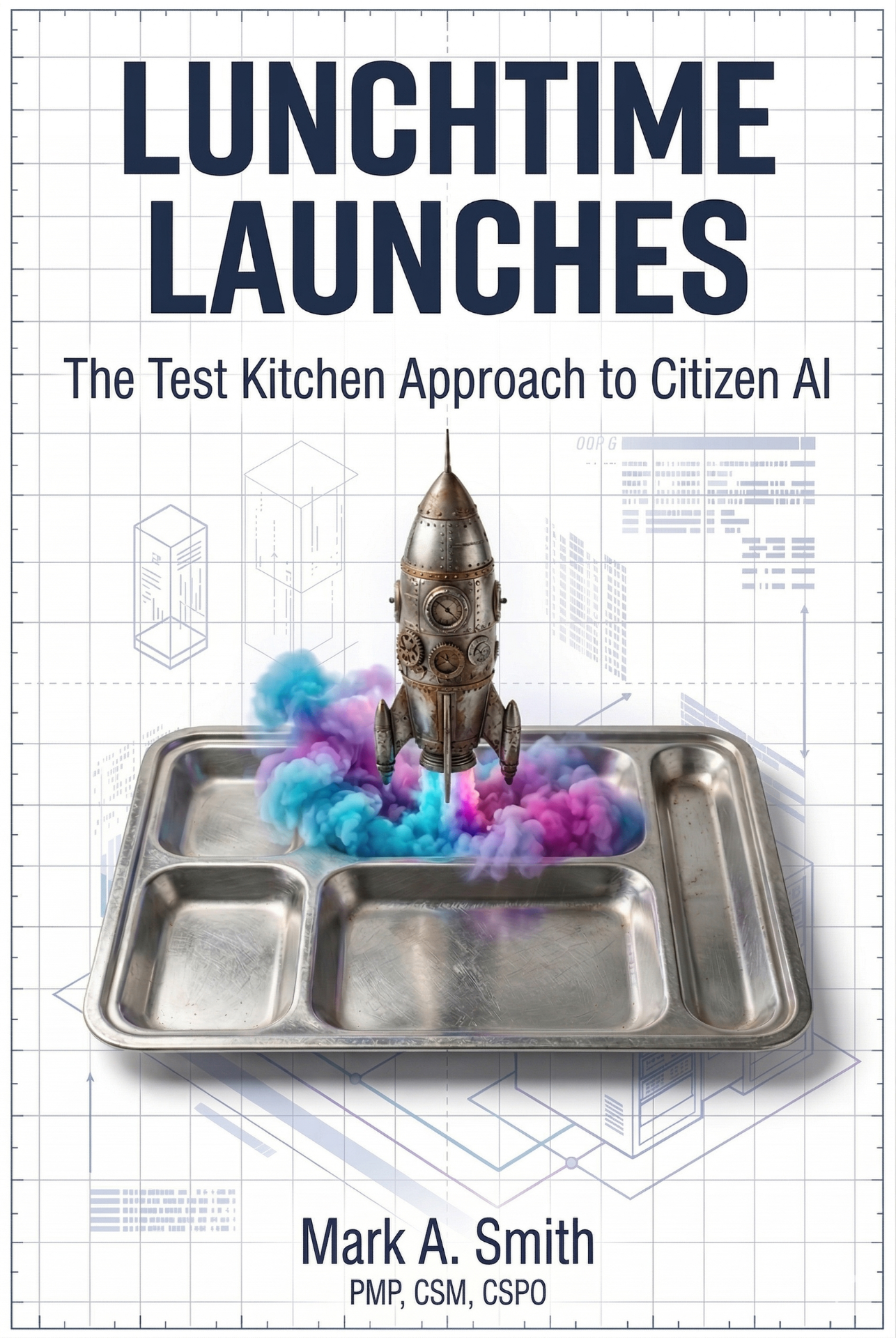
Book 3
Book 1
When Machines Prefer Waterfall
The Agentic Delivery Lifecycle and the Future of AI-Assisted Software Development
92% of companies are increasing their AI investment. Most are seeing diminishing returns. Your AI tools are generating more code than ever. So why is your team shipping less? Every engineering leader adopting AI hits the same wall. Developers produce code at ten times the speed, but features take longer to reach customers. Review queues overflow. Quality slips. This is the Velocity Paradox — and it's not a tooling problem. It's a methodology problem. When Machines Prefer Waterfall introduces the Agentic Delivery Lifecycle — a complete methodology for the age of AI-assisted development. The ideas took a career. The book took AI. That's the whole argument.
Agentic Delivery Lifecycle
A radical reimagining of how AI agents should work in software development.
Micro-Waterfall Methodology
Complete specifications enabling continuous AI generation without artificial latency.
10-100x Productivity
Case studies from Goldman Sachs, PwC, and Google demonstrate massive gains.
Scan with your phone to listen on ElevenReader
Unabridged
Abridged
Book 2
The Anti-Agile Manifesto
Why Specification Driven Development Wins
Your Agile process wasn't designed for AI. It's time to stop pretending it was. In the tradition of business novels like The Goal and The Phoenix Project, The Anti-Agile Manifesto drops you inside Nexus Dynamics, where VP of Engineering Maya Torres is watching her Agile-trained organization bleed quality despite adopting every AI coding tool on the market. Through Maya and her team, you'll watch the painful, practical discovery of why Agile breaks under AI and what replaces it: Specification-Driven Development — a return to a new kind of waterfall. You'll learn why Markdown outperforms JSON as an interface language for AI agents, how to structure specifications that eliminate hallucination at the source, and what happens to the roles of developer, product manager, and architect when coding becomes execution and specification becomes craft.
Business Novel Format
Learn through story — in the tradition of The Goal and The Phoenix Project.
Specification-Driven Dev
When AI finishes before the meeting ends, the spec becomes the product.
Real Production Patterns
Every pattern validated in production environments with real customers.
Book 3
Lunchtime Launches
The Test Kitchen Approach to Citizen AI
Your employees are already building software. 60% of enterprise apps are now created outside IT. Most companies don't know it until something breaks. A business analyst builds a tool over lunch that finds $47,000 in errors. By the following week, eleven unauthorized apps are running across the company. The CTO shuts them all down. The backlog stays at 341 items. Nobody wins. This is the Shadow AI Paradox — and it's not a security problem. It's an architecture problem. Lunchtime Launches introduces the Two Speeds model — a complete operating framework for running citizen innovation and enterprise engineering side by side. The frameworks came from a napkin sketch in a cafeteria. The book came from the question every C-suite is asking: how do we govern this without killing it?
Two Speeds Architecture
A governed sandbox for rapid citizen builds connected to an enterprise pipeline through a Bridge protocol that matches rigor to risk.
Entropy Tolerance Scale
Five levels of governance — from zero tolerance for pricing engines to maximum tolerance for personal tools — so dashboards don't get reviewed like mainframes.
The Flywheel Effect
How citizen innovation and agentic engineering accelerate each other, delivering 42% backlog reduction and $18M+ in projected value.
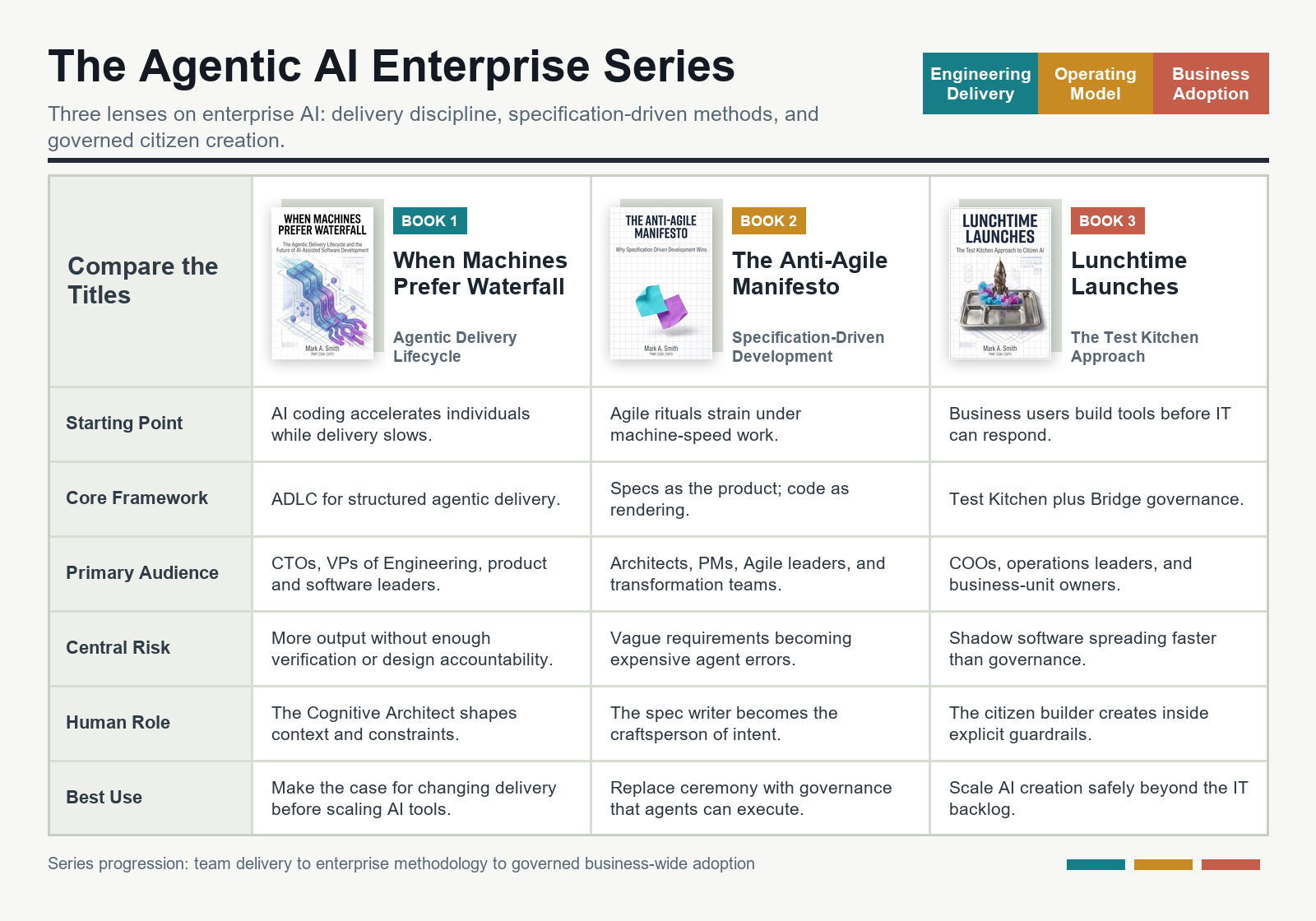
Compare the Titles
Three lenses on enterprise AI: delivery discipline, specification-driven methods, and governed citizen creation.
About the Author

Mark A. Smith
AI Product Manager & Thought Leader
Mark A. Smith is an AI Product Manager and thought leader specializing in AI-powered software development methodologies. With over two decades of experience in data science and product innovation at organizations including Entergy, NextEra Energy, EPRI, and HP, Mark challenges conventional Agile practices through his groundbreaking work on the Agentic Delivery Lifecycle (ADLC). He helps organizations transition from traditional Agile to AI-augmented continuous generation workflows.
Stay Updated
Get insights on AI-assisted development and be the first to know about new content from Mark A. Smith.